Several sites taking part in eDNA Expeditions 2026-2028 have already done their very first sampling event! From shy debuts to confident end-of-the-day manipulations, explore the insights, impressions, and feedback from the participants. Read more about what it takes to carry a successful sampling event, from careful planning to task division and keeping an eye on the weather.
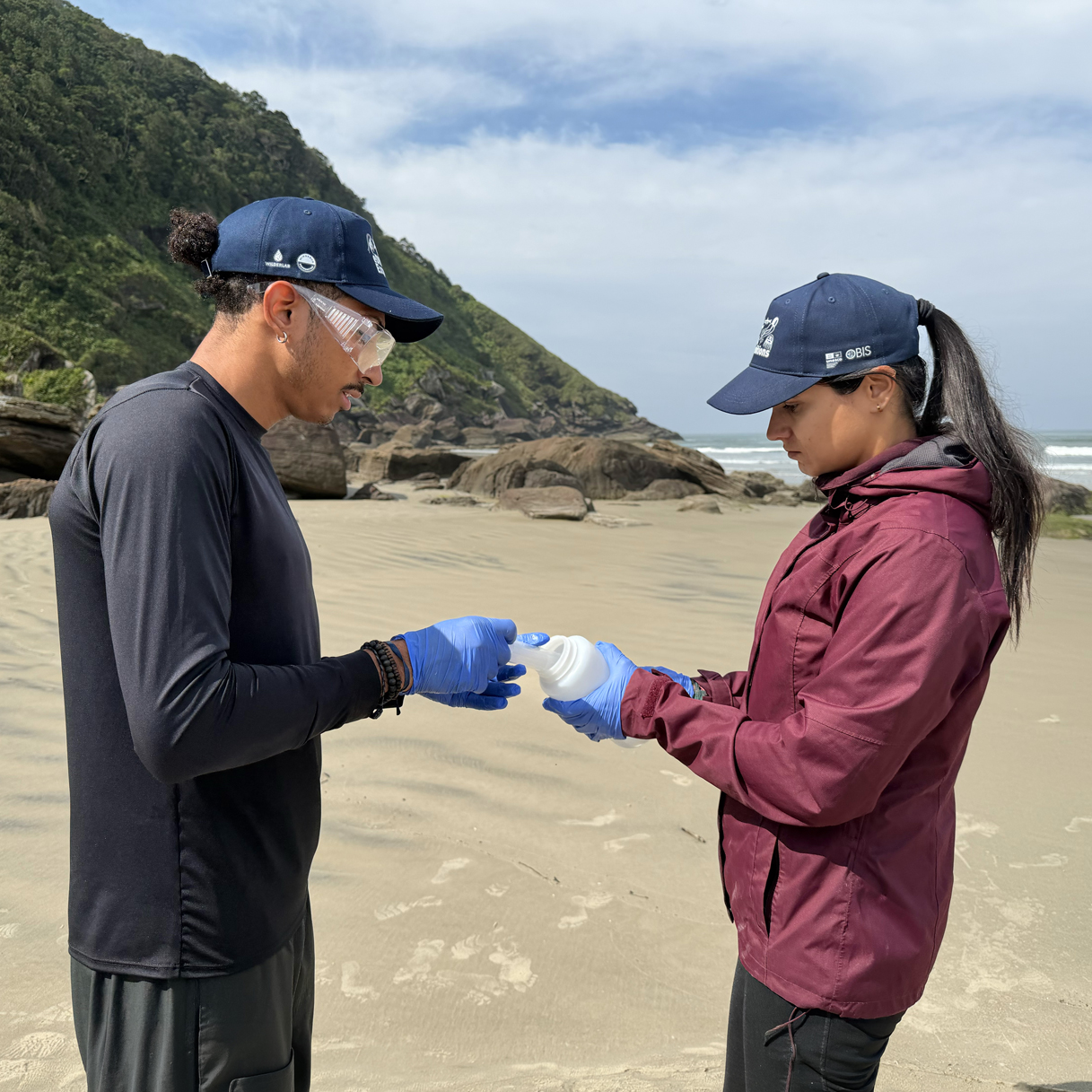
Filling a sampling syringe from a sampling bottle at Cananéia–Iguape–Peruíbe, Brazil, in August 2026. ©Jeniffer Teles
The numbers below give you an at-a-glance update on the progress of the eDNA Expeditions. You can have more detailed insights and see the progress for each site by choosing a location here.
Marine sites currently participating in eDNA Expeditions 2026-2028.
The science plans are site-specific assets co-developed with local teams to guide sampling priorities, establish monitoring goals, and ensure that the generated data will effectively create impact.
These sessions guide local teams on how the data generated will inform local conservation actions and provide them with the skills needed to collect eDNA samples following the project's protocol.
Scientists, rangers, students, and community members who have taken part in eDNA sampling events so far.
Seawater samples collected across all participating sites since the project's sampling campaigns began.
Distinct marine species detected so far through the biomolecular analysis of eDNA samples.
DNA sequences generated from the analysis of collected samples.
We aim to establish a global biomolecular observatory for marine life, helping to better understand our Ocean.
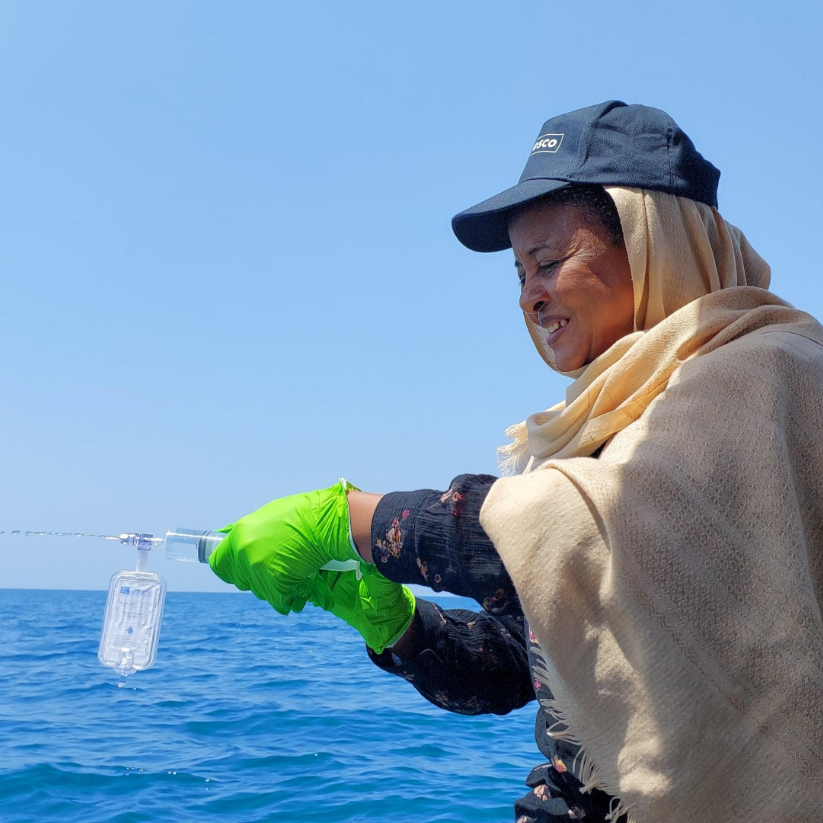
A woman sampling for eDNA at the Mukkawar Island Marine National Park in Sudan, during the first phase of the eDNA Expeditions. Photo: UNESCO / Musaab Hassouna
Powered by the Intergovernmental Oceanographic Commission (IOC) of UNESCO's Ocean Biodiversity Information System (OBIS) and supported by Minderoo Foundation in collaboration with Wilderlab, eDNA Expeditions 2026-2028 is a three-year initiative supporting 25 marine sites worldwide in using environmental DNA (eDNA) to better observe, understand, and protect ocean biodiversity.
Every three months, local teams collect seawater samples using a simple but scientifically robust protocol capable of revealing traces of marine life ranging from microbes to megafauna. Those samples are transformed into biodiversity insights that flow back to participating sites through dashboards and visualization tools co-designed with local teams.
The project is local by impact and global by design : each site uses eDNA Expeditions to address its own priorities, from detecting invasive species and monitoring ecosystem changes to supporting conservation and marine management decisions.
All resulting biodiversity information is openly shared through IOC's Ocean Biodiversity Information System (OBIS), helping strengthen global ocean knowledge and marine biodiversity observation worldwide.
eDNA Expeditions follows a circular workflow designed to transform seawater samples into decision-ready biodiversity insights.
1. Local teams collect samples: Scientists, rangers, technicians, students, and community members collect seawater samples at participating marine sites using a standardized environmental DNA protocol.
2. Samples are processed into biodiversity information: Specialized biomolecular analyses detect traces of marine life contained in the samples, generating biodiversity information across the tree of life.
3. Results return to the sites: The information is transformed into accessible dashboards and visualization tools co-developed with participating sites to support local interpretation, monitoring, and conservation priorities.
4. Data contributes to global ocean knowledge: All biodiversity data generated through the project is openly shared through OBIS, contributing to a better collective understanding of ocean life worldwide.
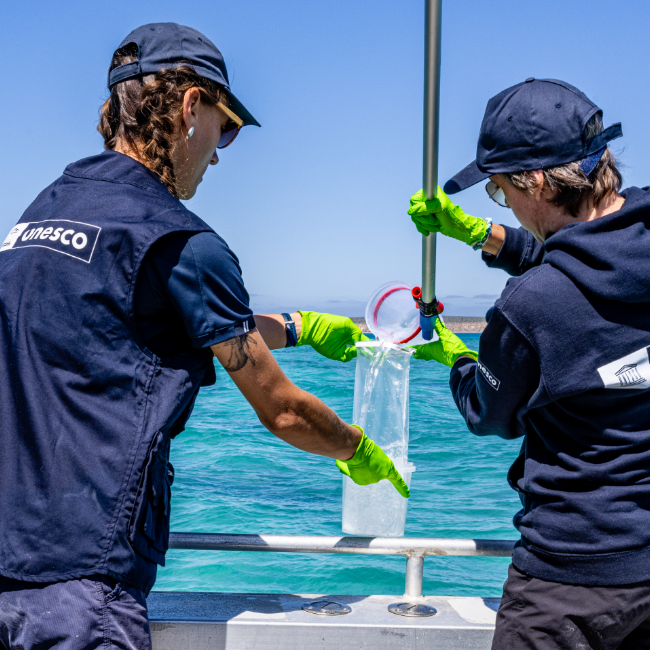
A sampling event at Shark Bay, Western Australia, during the first phase of the eDNA Expeditions. Photo: UNESCO
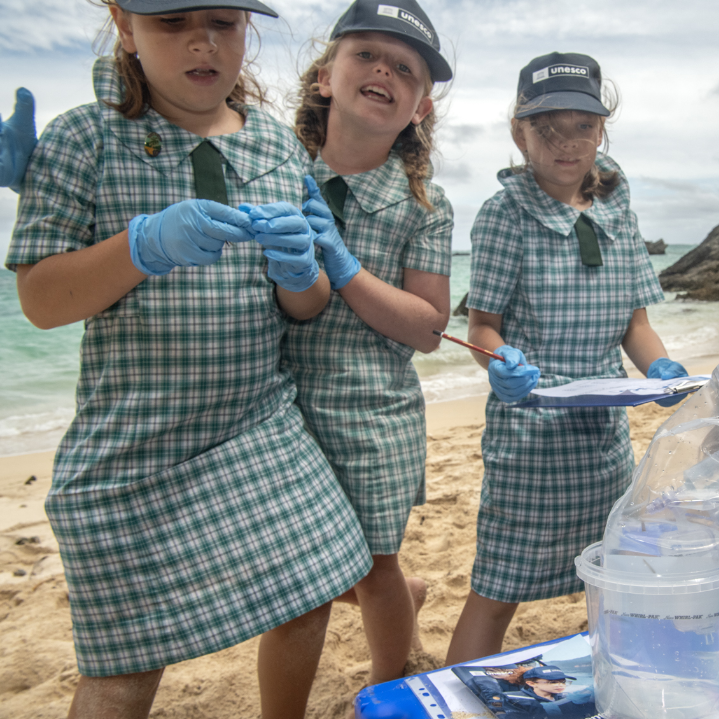
Schoolgirls sampling at Lord Howe Island Group, a UNESCO World Heritage Site in New South Wales, Australia, during the initial phase of eDNA Expeditions. Photo: Justin Gilligan / UNESCO
eDNA Expeditions 2026-2028 builds on the experience from a previous proof-of-concept phase that took place from September 2022 to July 2023: the eDNA Expeditions at UNESCO World Heritage marine sites.
That initial phase consisted of a single, one-off sampling event at 21 World Heritage marine sites. It involved 250 citizen scientists from 19 countries, who identified more than 4,000 species. The campaign detected 10 to 20% of local fauna, a work that would have taken years and millions of dollars using traditional survey methods.
This proof-of-concept established the world's first global use case for detecting ocean biodiversity through citizen science using shared eDNA methods. It demonstrated the potential of combining rigorous scientific sampling protocols, citizen science engagement, and cutting-edge observing technology to produce reliable, trusted results.
This project was made possible through the support of the Flanders UNESCO Science Trust Fund (FUST) and the General Flanders UNESCO Trust Fund, paving the way for eDNA Expeditions 2026-2028.
Participating sites access the high-resolution eDNA results generated from their local sampling campaigns. The project delivers high-quality, ready-to-use biodiversity data and insights through co-designed dashboards.
The eDNA results add a powerful biomolecular layer to monitoring activities at participating sites. The data reveal biodiversity patterns, flag unusual detections, and complement existing surveys—helping sites refine management plans and contribute more confidently to local, national, and global biodiversity reporting.
The project's eDNA sampling process is simple, hands-on, and scientifically robust. It creates opportunities for participating sites to involve schools, visitors, and local communities in concrete science-based actions that protect and advance knowledge of their marine environment.
eDNA Expeditions 2026-2028 officially begins with the selection and onboarding of 25 marine sites worldwide. Initial training programs and equipment distribution to participating sites.
Marine sites begin their first eDNA sampling campaigns. Data collection protocols are established and initial biodiversity assessments are conducted across all participating locations.
Comprehensive data analysis begins with the integration of eDNA samples into the global OBIS database. Advanced bioinformatics pipelines process samples and generate actionable insights for marine conservation.
Results from eDNA Expeditions 2026-2028 are published and shared globally. The project demonstrates the power of standardized marine biodiversity monitoring and sets the foundation for future ocean observation initiatives.
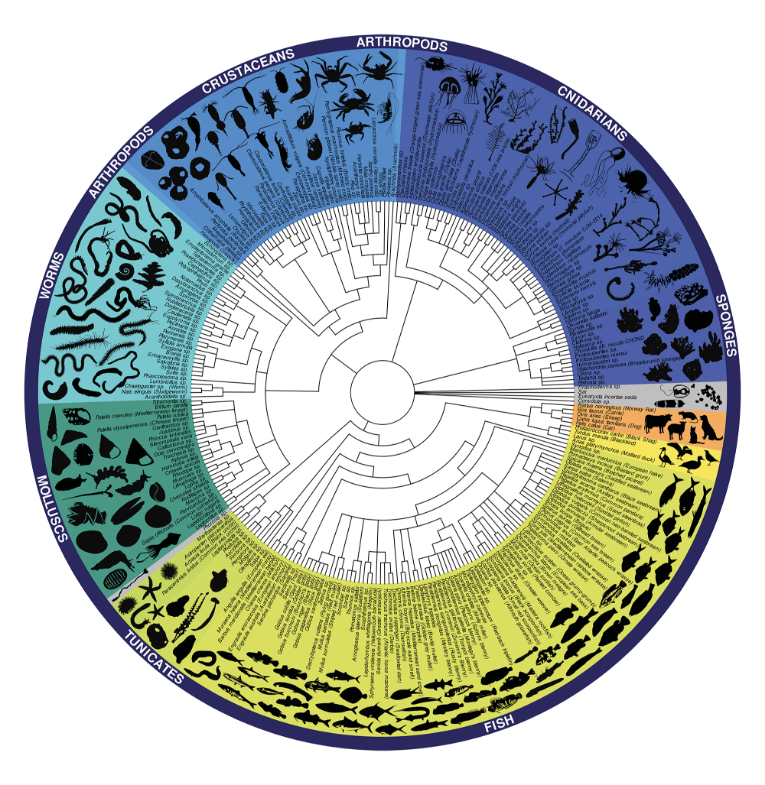
eDNA provides a powerful and scalable way to capture the tree of life from just a few litres of seawater. This wheel maps eDNA samples taken from various sites around the port of Nice, France, in 2025.
Click here to view the wheel in high definition >
The file might take a moment to load!
